Psychedelic-Assisted Therapy (PAT) #
Psychedelic-assisted therapy (PAT) combines a therapeutic-dose empathogen with IFS practice to support more rapid emotional processing, parts work, and healing.
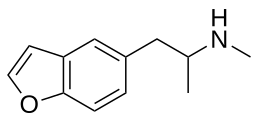
5-MAPB #
I recommend 5-MAPB (5-(N-methyl-2-aminopropyl)benzofuran), a legal, unscheduled empathogen with a pharmacological profile similar to MDMA.1 Like MDMA, 5-MAPB promotes feelings of emotional openness, empathy, and reduced fear creating a window in which difficult material becomes more accessible. 5-MAPB is also less physically stimulating than MDMA—a good fit for the sedentary, seated work of a talk-therapy session.2
You can source 5-MAPB from xumtrip (PLÜR IMMERSE), an American supplier that publishes third-party Certificates of Analysis (COAs). See the manufacturer’s product page for the latest COA; a sample COA from January 2026 is available here.
How a Session Works #
A PAT session typically unfolds in three phases:
- Preparation — We meet beforehand (standard session) to set intentions, review your history, and address any concerns.
- Medicine session — You self-administer your chosen dose. The experience lasts 4–6 hours. I hold space via video conferencing while you remain safely in your own home. Doses in PLÜR tablets:
- 3 tablets (~75 mg) — Light
- 4 tablets (~100 mg) — Moderate
- 5 tablets (~125 mg) — Standard
- Integration — We resume regular sessions.
To allow adequate neurological recovery, medicine sessions are spaced at least 3 months apart.3
Contraindications #
I am not a doctor and cannot provide medical advice. Please review the manufacturer’s product page for safety information and consult your physician before proceeding.
Legal Status #
5-MAPB is not scheduled under the US Controlled Substances Act as of April 2026. It is sourced domestically. You are responsible for understanding applicable law in your own jurisdiction.
Cost #
I charge my usual hourly rate. Most PAT programs charge $1,000–$3,000 or more per session; at my standard rate, this is among the most affordable PAT options available. You can schedule 4–5 consecutive hours to span the duration of the effects.
FAQ #
What about other psychedelics?
Some people pursue therapeutic work with other psychedelics, such as psilocybin, ketamine, or LSD. I have opinions about that. If you’re curious, it’s worth raising in a session so we can talk it through together.
What if I’ve never done psychedelics before?
That’s fine—many clients are first-timers. Unlike some PAT-trained therapists who boldly guide sessions with no firsthand experience, I bring extensive personal experience with a range of psychedelics.4
Can I do this if I’m on antidepressants or other medications?
Possibly, but this requires medical guidance. Some medications (notably SSRIs and other serotonergic drugs) can interact with psychedelics. I am not a medical doctor. Please discuss your specific medications with your psychiatrist or physician.
Notes #
The Federal Analogue Act treats a substance as Schedule I if it is “substantially similar” to a scheduled substance and intended for human consumption. Courts and legal scholars have criticized this standard as unconstitutionally vague. The Act provides no scientific or legal definition of “substantially similar,” leaving individuals without fair notice of what conduct is prohibited. 5-MAPB is unscheduled and legal. Comparison with MDMA is offered for informational purposes only. ↩︎
Frequent or high-dose empathogen use is associated with cumulative serotonergic stress. A 3-month minimum interval is consistent with risk-reduction guidance derived from research on MDMA neurotoxicity (Parrott, A.C. [2013]. “MDMA, serotonergic neurotoxicity, and the diverse functional deficits of recreational ‘Ecstasy’ users.” Neuroscience & Biobehavioral Reviews, 37[8], 1466–1484). ↩︎
Dames, S., Watler, C., Kryskow, P., Allard, P., Gagnon, M., Taylor, W., & Tsang, V. W. (2024). Psychedelic-assisted therapy training: An argument in support of firsthand experience of nonordinary states of consciousness in the development of competence. Psychedelic Medicine, 2(3), 130–137. ↩︎